
Basic Salary, DA and PF: Understanding the 50% Wage Rule
Understand the 50% allowance add-back, why Basic is not simply half of CTC, and how statutory wages relate to PF coverage and contributions.
Reviewed on 9 October 2026
For HR teams, “Basic must be 50% of CTC” sounds like a simple payroll instruction. It misses the actual test: classify remuneration correctly, then add back qualifying excluded amounts above the statutory limit. Basic Salary, statutory wages and the PF contribution base can therefore be different numbers.
What is in force?
The Labour Codes took effect on 21 November 2025; the Ministry confirms that date for the wage definition in its 16 March 2026 additional FAQs. The final Code on Wages (Central) Rules, 2026 were notified on 8 May 2026, with commencement on Gazette publication. Older documents labelled “draft” are consultation texts, not final rules. Check the appropriate government's rules for your establishment.
Five salary terms that should stay separate
Basic Salary is the core component shown in the employment agreement and payslip. DA, or Dearness Allowance, is a separate cost-of-living component where applicable. Neither is a synonym for total pay.
Gross salary generally means earnings before employee deductions for the month. CTC is the employer's total compensation cost, often including employer contributions and benefit provisions. Take-home pay is what remains after deductions.
Statutory wages are calculated using the relevant legal definition, rather than by copying a payslip subtotal. The PF contribution base is the eligible wage amount on which contributions are calculated after applying the relevant scheme, ceiling and higher-wage arrangement. EPFO's current wage-ceiling FAQ, Q14 and Q24–25 explains why CTC and gross salary do not determine PF liability by themselves. Open the PDF beside the wage-ceiling announcement on that portal.
How the 50% allowance add-back works
The Ministry’s wage definition FAQ explains that wages include Basic, DA and retaining allowance. The first proviso to Section 2(y) of the Code on Wages tests excluded payments under clauses (a)–(i): where their total exceeds 50% of remuneration calculated under that provision, the excess is added back to wages, unless a different percentage is notified.
Companies can offer allowances above 50%. The consequence is a statutory calculation adjustment; the excess cannot simply remain outside wages for the relevant calculation. This does not automatically rename an allowance as Basic on the payslip or increase the agreed salary. Contributions and take-home pay may nevertheless change.
Why “Basic equals half of CTC” is misleading
The test concerns remuneration and component classification, not one compulsory Basic percentage. DA and retaining allowance count too. Retaining allowance is paid to retain services during a period when an establishment is not working.
HRA, conveyance, employment-related special expenses, overtime, commission and specified bonus or employer pension/PF contributions have particular exclusions, subject to the add-back. A generic “special allowance” is not excluded merely because of its name. Gratuity and retrenchment/termination payments sit outside the clauses (a)–(i) add-back basket. Read the parallel statutory definition in Section 2(88) of the Social Security Code, including special treatment for certain purposes and remuneration in kind.
The Ministry's March clarification, Q1 includes employer PF/pension contributions and statutory bonus in the remuneration calculation, but excludes gratuity, ESI and other retirement benefits. That is another reason not to substitute either CTC or monthly gross mechanically.
Illustrative example: ₹50,000 counted remuneration
Assume ₹50,000 is the remuneration counted under the rule, comprising ₹8,000 Basic and ₹42,000 qualifying excluded allowances. There is no DA or retaining allowance, and no other component requiring adjustment. This is a deliberately simplified illustration, not CTC and not a template for every salary structure.
| Item | Calculation | Amount |
|---|---|---|
| Remuneration counted | Basic + qualifying excluded allowances | ₹50,000 |
| 50% threshold | ₹50,000 × 50% | ₹25,000 |
| Excess to add back | ₹42,000 − ₹25,000 | ₹17,000 |
| Statutory wage base | ₹8,000 + ₹17,000 | ₹25,000 |
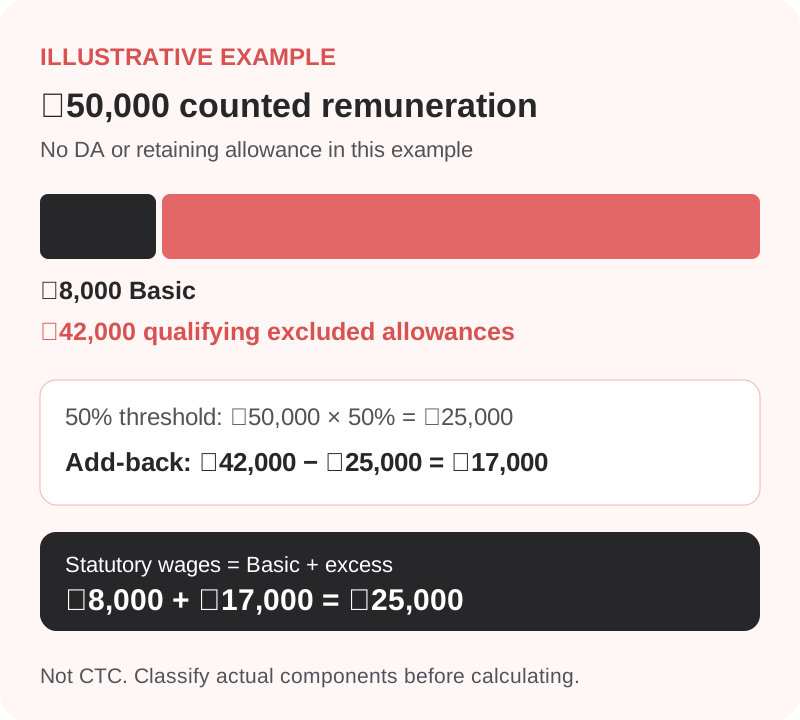
Basic remains ₹8,000 in this illustration. The statutory wage base becomes ₹25,000. Before applying the same arithmetic to your payroll, verify which components belong in the denominator and exclusion basket.
How this relates to PF
Establishment coverage comes first: EPF generally applies to establishments with 20 or more employees, with voluntary coverage and other applicable conditions. Employee membership history, exclusions and scheme requirements also matter; consult the Social Security Code, First Schedule and Chapter III.
For covered employees, identify the legally relevant PF wages, including applicable add-backs, before applying contribution provisions. Do not assume Basic + DA alone always resolves that legal assessment.
According to EPFO's revised-ceiling FAQ, Q1, Q7, Q12 and Q21–22, S.O. 5109(E) dated 17 September 2026 raised the monthly ceiling from ₹15,000 to ₹25,000 from that date. The standard rate illustrated is 12% each for employee and employer; confirm any applicable rate exception. On a ₹25,000 contribution base, that is ₹3,000 each for a full month. The employer's share is allocated between EPF and EPS where EPS applies.
Lower wages use the applicable lower base. Existing membership does not simply end when pay rises; higher-wage arrangements require review under scheme conditions, and employee voluntary contributions do not automatically require an equal additional employer contribution. September 2026 calculations must account for the change on the 17th, rather than apply the new ceiling to the whole month indiscriminately.
HRA's 40%/50% figures are a separate tax test
The Income Tax Department's HRA guidance describes exemption as the least of actual HRA, rent minus 10% of the defined salary, and 50% of that salary for Delhi, Mumbai, Kolkata or Chennai, or 40% elsewhere. The salary definition and tax-regime eligibility matter. These are exemption limits, not mandatory HRA amounts or the labour-code wage rule.
Practical salary-structuring guidance
Keep Basic + DA at least 50% of monthly gross salary as a practical structuring recommendation where suitable. It can simplify review, but is neither a universal legal requirement nor a compliance guarantee.
For each structure, document component classifications, calculate any add-back, check minimum wages separately, review PF membership and contribution limits, and reconcile payslips with statutory returns. Explain changes to deductions before payroll closes.
In the HRsaathi payroll code reviewed for this article, PF calculations use Basic + DA, followed by applicable limits and payroll proration. Automatic 50% allowance add-backs were not found in the inspected calculation paths. Payroll administrators should validate the statutory wage base independently; HRsaathi should not be assumed to enforce this rule automatically.
Short FAQ
Must Basic itself be 50%?
No. Review included components and qualifying exclusions, then calculate any excess.
Can allowances exceed 50%?
Yes. Qualifying excess amounts must be considered in statutory wages.
Does a ₹25,000 statutory wage base always mean ₹3,000 PF?
No. Coverage, contribution rate, membership, higher-wage arrangements and period proration must be checked first.
Can we change only the labels?
Labels do not replace classification. Keep contracts, payroll calculations and employee communication consistent.
This article is general information, not individual legal advice. Applicable rules depend on salary components, establishment coverage and employment circumstances; seek qualified advice for your structure.
Tags
Want to learn more about HRSaathi?
Discover how our HRMS can transform your workforce management